What Does Search Engine Marketing Look Like in Practice? 9 Examples
Real search engine marketing examples for Indian businesses: paid search, shopping ads, local listings, SEO content and AI answers, with what each one costs.

A founder in Pune runs a payroll software company with happy customers and almost no inbound leads. A Jaipur textile brand sells beautiful block-print bedsheets, but buyers searching for cotton bedsheets online keep landing on marketplace listings. Both businesses do good work. Neither shows up when a buyer types or asks the question that should lead to them.
Search engine marketing is how a business closes that gap. This guide skips the textbook overview and goes straight to examples: what each form of search marketing looks like on the screen, who it suits, what it costs in effort and money, and where it breaks. The examples use Indian businesses wherever they fit, because the economics of search in India differ from those in the US or UK.
Search engine marketing (SEM) is any work that puts a business in front of people at the moment they search for something it sells or knows about. In the narrow sense, SEM means paid search ads. In the wider sense used here, it covers paid ads, organic rankings, local listings and, by 2026, answers from AI assistants such as ChatGPT, Gemini, Claude and Perplexity. It matters to any business whose buyers research before they buy.

Why search is the channel worth studying
Search reaches people who have already decided they need something. That intent is why companies keep spending on it. According to the Search engine marketing entry on Wikipedia, as of May 2026 Google remained the leading search engine worldwide with a market share of 90.39%. For most Indian businesses, the paid and organic examples below are therefore Google examples.
The money follows the intent. Statista's search advertising overview reports that in 2024 search ad spending in the United States stood at 137 billion U.S. dollars. India is smaller but growing fast. The Ipsos and DigiPlus report on the state of digital marketing in India calls paid search the fastest-growing channel and puts digital media spend at ₹40,800 crore in FY24, a 29% growth over FY23.
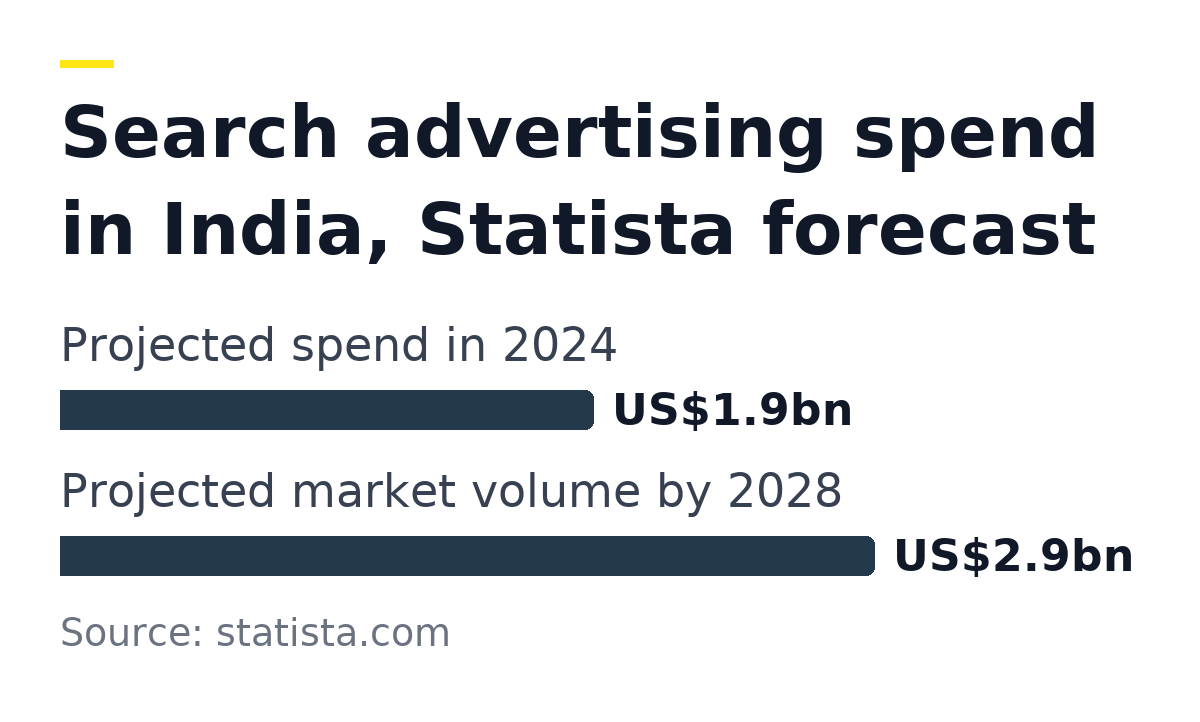
Statista's India search advertising outlook projected search ad spending in India to reach US$1.9bn in 2024, and expects an annual growth rate (CAGR 2024-2028) of 11.16%, reaching US$2.9bn by 2028. Those figures come from 2024 forecasts. In 2026 they mean one practical thing: more Indian businesses bid on the same keywords each year, so clicks get pricier and organic visibility becomes worth more.
Types of search engine marketing in digital marketing
There are four main types of search engine marketing in 2026: paid search, local search, organic search (SEO) and AI answer visibility (GEO and AEO). Each one puts a business in a different spot on the search results page or in the AI chat window, and each one is paid for differently.
| Type | Where it appears | How you pay | How fast it works | When it stops |
|---|---|---|---|---|
| Paid search | Sponsored results and shopping ads | Per click | Same day | When the budget stops |
| Local search | Map pack and business profile | Mostly time and reviews | Weeks | Slowly, if neglected |
| Organic search | Ranked links and featured snippets | Content and time | Months | Slowly, as content ages |
| AI answers | ChatGPT, Gemini, Claude, Perplexity, AI Overviews | Content and time | Months | Slowly, as sources change |
Display advertising is often grouped with search marketing, but banner ads appear on websites and apps whether or not someone is searching. This guide leaves display out and focuses on the channels where the buyer asks first.
Paid search examples
Paid search means an advertiser bids on keywords and pays when someone clicks the ad. Google decides which ad shows using the bid and an estimate of ad quality and landing page relevance. These examples show where paid search earns its cost and where it wastes money.
Example 1: a B2B SaaS company bidding on competitor-comparison searches
The Pune payroll company bids on searches such as "payroll software for small business India" and "[larger competitor] alternative". Its ad headline names the buyer's pain: "Payroll with PF, ESI and TDS built in". The ad sends the click to a comparison page that shows plans in rupees, compliance features and a demo booking form.
This works because the buyer is already shopping. The weak spot is cost. Comparison keywords attract every company in the category, so cost per click rises. A SaaS team should track cost per booked demo and cost per paying customer, not cost per click.
Example 2: a brand protecting its own name
A D2C skincare brand from Bengaluru bids on its own brand name. Without the ad, a reseller or a competitor can buy the top spot above the brand's own organic listing. Brand ads usually cost little per click because the ad is highly relevant.
The open question is whether those clicks are extra sales or sales the brand would have got anyway through its organic link. A simple test is to pause brand ads in one city for two weeks and compare total brand sales. If sales barely move, the spend was mostly paying for clicks the brand already owned.
Example 3: shopping ads for an ecommerce catalogue
The Jaipur bedsheet brand uploads its catalogue to Google Merchant Center. When someone searches "king size cotton bedsheet", a shopping ad shows a product photo, the price in rupees and the store name. The buyer sees the product before clicking.
- Product titles carry the words buyers use: material, size, thread count and print style.
- Prices and stock in the feed match the website, or Google may disapprove the products.
- Product photos are clear and consistent, because the image does most of the selling in a shopping ad.
- The landing page is the product page itself, not the homepage.
Shopping ads suit retail brands with clear prices and many products. They suit B2B services poorly, because there is no product card to show.
Local search example
Local search marketing gets a business into the map results that appear for searches with a place in them, or searches Google treats as local, such as "dentist near me". The main asset is the Google Business Profile.
Example 4: a clinic or showroom winning the map pack
A physiotherapy clinic in Kochi fills in every field in its Google Business Profile: services, hours, photos and the area it serves. It asks each patient for a review after the final session and replies to every review, including the critical ones. Its website has a page for each treatment that names the neighbourhood.
- Relevance: the profile categories and services match what people search for.
- Distance: how close the business is to the searcher or the place named in the search.
- Prominence: reviews, mentions on other sites and how well known the business is.
- Consistency: the same name, address and phone number everywhere the business is listed.
Local search costs little money but needs steady attention. It matters most to clinics, restaurants, showrooms, coaching centres and service businesses with a physical area. A SaaS company with customers across India gains little from it.
Organic search examples
Organic search marketing earns unpaid rankings by publishing pages that answer what buyers search for. The cost is in research, writing and updates, and the result builds over months. Unlike ads, a page that ranks keeps bringing visitors when no one is paying for each click.
Example 5: a comparison page that converts
The payroll company from Example 1 writes an honest page comparing its product with two larger rivals. The page covers price, compliance features, Tally integration and support hours. It states where a rival is better, for example for companies with more than 2,000 employees.
The page ranks for the same comparison searches the company was paying for in Example 1. Once it ranks, the company can lower its bids on those keywords. A buyer who reads an honest comparison often trusts the vendor that wrote it, so the page tends to convert well.
Example 6: a training firm growing through organic content
This one is a published case study. Prism Global Marketing Solutions worked with a global EDI training and consulting firm on search engine optimisation. According to the Prism Global Marketing case study, total website traffic increased 317%, organic traffic increased 52% and new online leads increased 155%.
The lesson for a niche B2B firm is that organic search can produce leads in a narrow, technical field. Few people search for EDI training, but those who do are serious buyers. A small number of well-matched visitors can be worth more than a large number of casual ones.
Example 7: an ecommerce category page that answers questions
The Jaipur bedsheet brand rewrites its "Cotton Bedsheets" category page. Above the product grid, a short introduction explains thread count, the difference between percale and sateen, and how hand block prints are made. Below the grid, a few short answers cover washing, colour fading and sizes for Indian beds.
The page now matches searches like "is 300 thread count good" as well as the plain product search. Shoppers who arrive with a question find the answer and the products on the same page. This is the same body of content that helps the brand show up in AI answers, which leads to the next type.
AI answer examples
AI answer visibility means a business is named, quoted or linked when someone asks an AI assistant a question. Telliscope's homepage cites G2's 2026 AI Search Insight Report, which says 51% of B2B software buyers start research with AI more often than Google. For a SaaS company, being absent from those answers means missing many buyers at the first step.
There is no ad slot to buy in most AI answers in 2026. An assistant builds its answer from sources it trusts, so visibility comes from content and reputation. How ai search chooses those sources is its own subject. The two examples below show what being chosen looks like.
Example 8: a SaaS product named in a ChatGPT answer
A finance lead asks ChatGPT: "What is the best payroll software for a 60-person company in India that uses Tally?" The answer names four products. The Pune company appears because its site has clear pages on Tally integration, pricing in rupees and support for Indian compliance, and because review sites and partner pages mention it in the same terms.
- Specific facts on the company's own site that an assistant can quote, such as plan prices, limits and integrations.
- Consistent descriptions of the company across its site, review sites and partner directories.
- Pages that answer the exact question in plain words near the top.
- Content that stays current, because outdated prices or features give an assistant a reason to prefer another source.
Example 9: a direct answer quoted from a how-it-works page
A shopper asks Perplexity: "How do I stop a block-printed cotton bedsheet from fading?" The answer quotes three short steps from the Jaipur brand's care guide and links to it. The shopper clicks through, reads the guide and sees the products.
This is answer engine optimisation (AEO): writing a page so that one short passage answers one question completely. The same passage can appear as a featured snippet on Google and as a quoted answer in an AI assistant. Telliscope's homepage cites Adobe Digital Insights (2026), which reports a higher conversion rate for AI-referred visits to retail sites, at 42%. A visitor who arrives from an answer has already been told why the page is useful.
How paid, organic and AI search work together
The four types work best when one feeds the next. Paid search shows which keywords convert. Organic content then targets those keywords so the business can spend less on them. The same organic content gives AI assistants something accurate to quote.
Paid search as research. A few weeks of ads on 30 or 40 keywords shows which searches lead to demos or sales. That data is quicker to get than organic ranking data, and it tells the content team which pages to write first.
Organic content as the lasting asset. Once a comparison page or category page ranks, the business keeps the traffic without paying for each click. Bids on that keyword can drop, and the budget moves to newer or more competitive searches.
AI visibility as the multiplier. Pages with clear facts and direct answers are the pages AI assistants quote. Telliscope's homepage cites the Cloudflare CEO (2026), who estimates that about 60% of web requests come from bots, including AI agents. Content that machines can read and quote reaches buyers through both channels.
Choosing your mix by business type
The right mix depends on what you sell, who buys it and how long they take to decide. The table below states a starting point; the honest answer for any one business comes from its own data.
| Business type | Lead with | Add next | Usually skip |
|---|---|---|---|
| B2B SaaS | Comparison and use-case content | Paid search on high-intent keywords | Map listings |
| Ecommerce or D2C | Shopping ads and category pages | Care guides and buying guides | Broad brand awareness ads |
| Local service business | Google Business Profile and reviews | Service pages by area | National keywords |
| Niche B2B services | Detailed topic content | Small paid tests | Shopping ads |
Founders and small business owners. With a small budget, ads can drain money before they teach anything. A better start is a short paid test to find converting keywords, then steady organic content on those topics.
Marketing leads and content managers. The constraint is often time, not ideas. A plan that ties each page to one buyer question and one keyword keeps the team from writing content no one searches for.
B2B SaaS growth teams. Long sales cycles mean the first touch often happens months before the demo. Comparison, alternative and integration pages tend to earn the most from both Google and AI assistants.
Ecommerce and retail brand managers. Shopping ads bring quick sales, but margins shrink as clicks get pricier. Category pages and buying guides lower the cost of each sale over time.
Where search marketing goes wrong
Most failed search marketing has the same few causes. None of them is about picking the wrong platform.
- Sending ad clicks to the homepage instead of a page that matches the search.
- Bidding on broad keywords such as "software" or "bedsheets" that attract browsers, not buyers.
- Writing content about the company instead of about the buyer's question.
- Publishing pages once and never updating prices, features or screenshots.
- Describing the business differently on the website, review sites and directories, which confuses both Google and AI assistants.
- Measuring clicks and traffic instead of demos, leads and sales.
Comparing tools helps here too. Writing tools such as Jasper and Writesonic produce drafts quickly, and page-level optimisers such as Surfer score a draft against keywords. Neither job covers the whole programme: research into what buyers ask, a plan, the company's own knowledge, publishing, updates and tracking across Google and AI assistants. That gap is where most small teams stall.
Telliscope is built for that gap. It researches what buyers search for on Google and where the business appears in AI answers, turns the findings into a content plan, and drafts articles from the company's own knowledge (Company DNA). The Starter plan costs ₹14,999 per month plus GST, with up to 15 articles a month for teams that review and approve content themselves. The Growth plan costs ₹44,999 per month plus GST, with up to 20 articles a month and human editorial review, custom images, infographics and managed execution. Both plans track AI visibility across ChatGPT, Gemini, Claude and Perplexity.
Related: What Is SEO and How Does It Work? The Basics for Busy Businesses
FAQ
What is an example of SEM?
A simple example of SEM is a Jaipur bedsheet brand running a Google Shopping ad that shows a product photo and rupee price when someone searches "king size cotton bedsheet". A wider example is the same brand ranking organically for that search and being quoted by an AI assistant when a shopper asks how to care for block-printed cotton.
If your business does good work but buyers cannot find it on Google or in AI answers, start with the questions they already ask. Telliscope researches those questions, plans the content and writes it from your own knowledge. Book a demo with Telliscope to see which searches and AI answers your business is missing, and what a first month of content would cover.