How Does AI Search Pick Which Businesses to Recommend?
Learn how AI search tools choose which businesses to name in their answers, why strong companies get left out, and what kinds of content earn a mention.

A prospect asks ChatGPT for the best inventory software for a mid-sized Indian distributor. The answer names four companies. Yours is not one of them, even though your product fits the brief better than two of the four. You never see that conversation. You only notice that demo requests have gone flat while your Google rankings look fine.
This is the problem many founders, marketing leads and ecommerce managers describe in 2026: good work that AI assistants do not seem to know about. The cost is real. G2's 2026 AI Search Insight Report says 51% of B2B software buyers start research with AI more often than Google. If the assistant leaves you out of the shortlist, the buyer may never reach your website at all.
This guide explains how AI search decides what to say and whom to name, why capable businesses get skipped, and which kinds of content change that. It assumes you already know what AI search is and focuses on the selection mechanics underneath.
AI search is the use of AI assistants such as ChatGPT, Claude, Perplexity and Google's AI features to answer questions directly in written replies, often naming specific products, brands and sources. It matters to any business whose buyers research before they buy, because the assistant's answer increasingly decides which companies make the shortlist.

Why strong businesses go missing from AI answers
Strong businesses go missing because AI assistants can only recommend what they can find, read and confidently describe. Quality of service is invisible to a language model unless it is written down somewhere the model can reach.
Most under-discovered companies share a few patterns. Their website explains the product in internal language. Their best proof sits in sales decks and customer calls. Their blog, if it exists, targets broad keywords and never answers the specific questions buyers type into a chat window.
- Product pages describe features without saying who the product is for or what problem it solves.
- Pricing, integrations and limits are hidden behind a demo form, so the assistant cannot answer basic buyer questions about you.
- Few pages answer comparison questions such as which tool suits a team of a given size or industry.
- Customer outcomes live in PDFs and slide decks that assistants rarely read.
- The company is rarely described by independent sites, so the assistant has little outside confirmation.
None of these is a quality problem. Each one is a documentation problem. That distinction matters, because documentation is something a business can fix.
How an AI assistant builds an answer
An AI assistant builds an answer from two places: what it learned during training and what it retrieves from the web at the moment the question is asked. Different assistants weight these differently, and the same assistant can switch between them depending on the question.
Trained knowledge
During training, a model reads a very large body of public text. It learns which brands are commonly linked with which problems. If many pages describe a Bengaluru payroll tool as the simple option for startups, the model absorbs that association. If almost nothing describes your company, the model has no association to draw on.
Trained knowledge also has a cut-off date. A product launched or repositioned after that date may be missing or described in outdated terms. This is why newer companies often find assistants describing them inaccurately or not at all.
Live retrieval
When an assistant searches the web before answering, it behaves like a fast, impatient researcher. It sends one or more queries, pulls back a set of pages, reads the parts that look relevant and writes an answer from them. Perplexity does this on almost every question. ChatGPT and Claude do it when a question needs current or specific information.
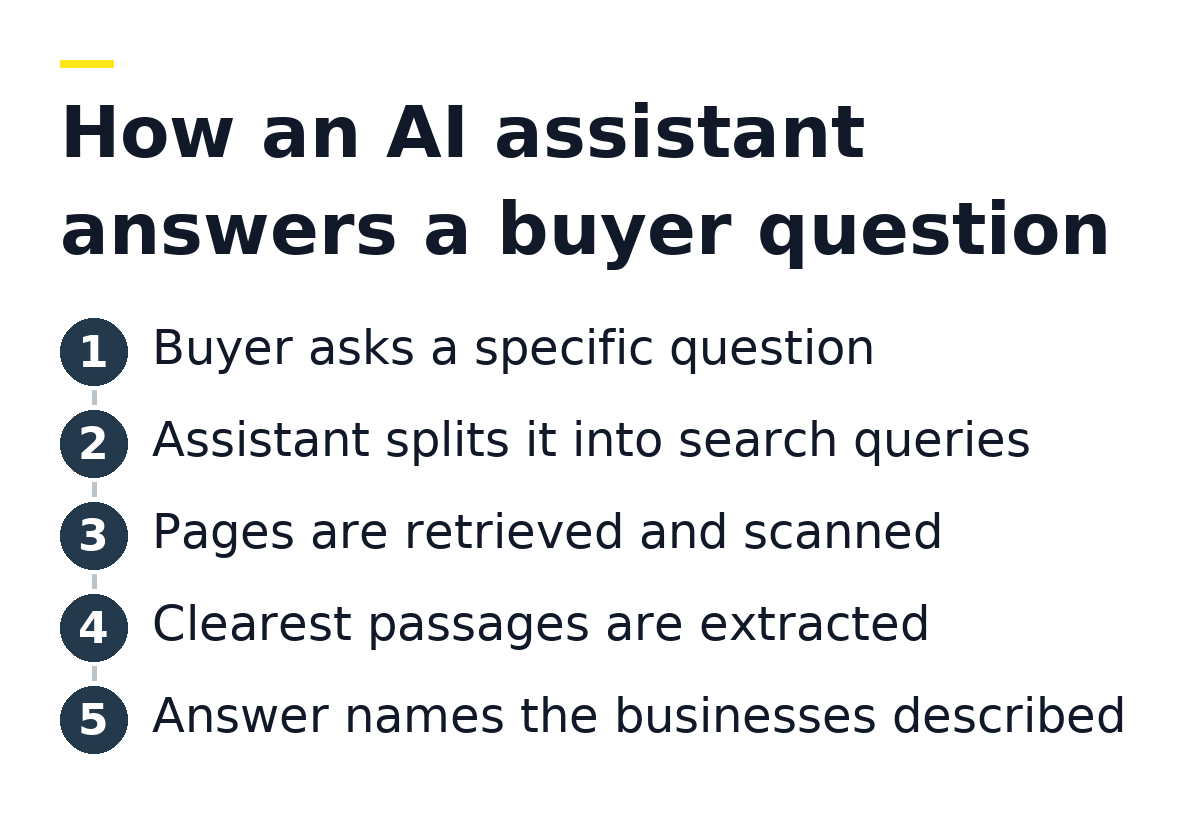
In practice, the process looks like this. A buyer asks which Shopify apps help Indian D2C brands reduce cash-on-delivery returns. The assistant breaks that into searchable pieces, finds pages that address COD returns specifically, extracts the clearest passages and names the businesses those passages describe. A page that answers the exact question in plain sentences has a far better chance of being used than a general page about returns.
What makes a page worth citing
A page is worth citing when it gives a clear, specific, self-contained answer to a question a buyer is likely to ask. Assistants favour passages they can lift and trust without rewriting much.
Direct answers near the top. A section that opens with the answer in one or two sentences is easy to quote. A section that warms up for three paragraphs before reaching the point is easy to skip. This is the core of AEO, the practice of shaping content into direct answers.
Specific detail. An assistant asked about GST-compliant invoicing tools for small manufacturers will prefer a page that names GST, invoice formats and the size of business it suits. Vague claims such as easy to use and powerful give it nothing to repeat.
Clear structure. Descriptive headings, short paragraphs and tables comparing options on the same points help retrieval systems find the right passage. One idea per paragraph means each paragraph can stand on its own when quoted.
Consistency across sources. When your website, review profiles, partner pages and press mentions describe your business the same way, an assistant can state that description with confidence. Conflicting descriptions lead to hedged answers or omission.
Much of this overlaps with search engine optimisation seo basics: crawlable pages, sensible headings, useful content. The difference is the unit of value. Traditional search ranks pages. AI search extracts passages and assembles them into a new answer.
How AI search on Google differs from standalone assistants
AI search on Google draws heavily on Google's own index and ranking signals, while standalone assistants run their own retrieval and lean more on trained knowledge. A page that ranks well on Google has a head start in Google's AI features, but that advantage does not automatically carry over to ChatGPT or Claude.
The table below shows the practical difference for a business trying to be visible in each.
| Surface | Main source of answers | What helps you appear |
|---|---|---|
| Google AI features | Google's search index | Strong organic pages with direct answers |
| ChatGPT | Training data plus web search when needed | Wide, consistent mentions and clear pages |
| Claude | Training data plus web search when enabled | Accurate, well-structured descriptions of your offer |
| Perplexity | Live web retrieval on most questions | Specific, quotable pages that match buyer questions |
The common thread is content that answers buyer questions clearly. The weighting differs, which is why a single traditional SEO plan rarely covers all four.
Which AI search engine matters most for your business
The AI search engine that matters most is the one your buyers use, and for most businesses that means more than one. There is no single best AI search engine for visibility, because buyers spread their research across tools.
- B2B SaaS buyers comparing vendors often use ChatGPT or Claude for shortlists, then Perplexity or Google to check details.
- Ecommerce shoppers in India often meet AI answers inside Google before they ever open a separate assistant.
- Technical buyers such as engineers and ops leads tend to test several assistants and compare what each says.
- Founders researching service providers often ask conversational questions that favour chat assistants.
The useful habit is to check. Ask each assistant the questions your buyers ask, in their words, and note who gets named. Repeat it monthly. Answers shift as models update and new pages appear, so a single check tells you little.
Ask the assistants your buyers' real questions every month and record which businesses are named. The gap between your expertise and your presence in those answers is the work to be done.
What kinds of solutions work
The solutions that work turn what a business already knows into public, specific, well-structured answers, then keep measuring and improving them. Four approaches tend to deliver results.
- Build content from buyer questions, starting with the comparison, fit and pricing questions that decide shortlists.
- Publish the knowledge locked in sales calls, onboarding documents and support tickets as clear web pages.
- Keep descriptions of your company consistent across your site, directories, review platforms and partner listings.
- Track visibility across Google, ChatGPT, Claude and Perplexity, and update pages that are not being cited.
Some teams handle this in-house with a content lead and a regular writing cadence. Others use AI writing tools such as Jasper or Writesonic, then find they still need strategy, company-specific knowledge and visibility tracking around the drafts. The writing is rarely the hardest part. Knowing which questions to answer, and proving the answers are getting picked up, usually is.
Telliscope is one way to cover the whole loop. It combines human content strategy with a company's own knowledge, called Company DNA, to write, publish and improve content across SEO, GEO and AEO. Its GEO visibility tracker monitors searches across the four AI platforms named in this guide. The Starter plan costs ₹14,999 per month plus GST for 15 articles a month, and Growth at ₹44,999 per month plus GST adds human review and managed execution.
If your business does good work but rarely appears in AI answers, list the five questions your best customers asked before buying, then see how Telliscope turns them into researched content and tracks whether ChatGPT, Claude, Perplexity and Google start naming you.