What Makes a Website SEO-Optimised? The Parts That Decide Visibility
An SEO-optimised site is built so search engines and AI assistants can find, understand and trust it. See the parts that matter and how they work together.
Two websites can sell the same product at the same price and still get very different results from search. One shows up when a buyer in Bengaluru asks Google or ChatGPT for a solution. The other sits unseen, even though the business behind it does equally good work. The difference is rarely one trick. It is usually how the whole site is built and kept up.
This guide looks at a website as a single system. Instead of a checklist of tasks, it explains the parts that make a site easy for search engines and AI assistants to read, and why those parts depend on each other. It is written for founders, marketing leads, SaaS growth teams and ecommerce managers who already know what SEO is and want to understand what separates an optimised site from an ordinary one.
An SEO-optimised site is a website whose structure, pages and content are set up so search engines can find and rank it, and AI assistants can understand and quote it. It matters to any business that wants buyers to discover it without paying for every visit.

Why the whole site matters more than single pages
Search engines judge pages, but they read those pages in the context of the site around them. A strong article on a site with broken links, thin product pages and no clear structure has to work much harder to be found. The same article on a well-organised site benefits from everything around it.
Think of a Mumbai-based HR software company with a single excellent blog post on payroll compliance. If that post links to nothing, and nothing links to it, search engines see an isolated page. If the site also has a payroll product page, a set of related guides and clear navigation between them, the same post becomes part of a body of work on one subject. That context is what site-level optimisation builds.
Site-level optimisation has several layers. Each one supports the others:
- A technical foundation that lets machines reach and read every important page
- An architecture that groups related pages and shows which ones matter most
- Content that answers the specific questions buyers ask
- Trust signals that show a real business stands behind the pages
- Upkeep that keeps all of the above accurate as the business and search change
The foundation: a site machines can read
Before any page can rank or be quoted, a crawler has to reach it, load it and understand it. This layer is invisible to most visitors, which is why it is often neglected. When it fails, no amount of good writing can make up for it.
Crawling and indexing
Crawling is a search engine visiting a page. Indexing is the search engine storing that page so it can show it in results. A page that is never indexed cannot rank, however useful it is. Common blockers include a robots.txt file that accidentally hides whole folders, pages marked noindex during a redesign and never changed back, and important pages that no other page links to.
An XML sitemap helps by listing the pages a business wants found. A small sample looks like this:
<?xml version="1.0" encoding="UTF-8"?>
<urlset xmlns="http://www.sitemaps.org/schemas/sitemap/0.9">
<url>
<loc>https://example.in/payroll-software</loc>
<lastmod>2026-01-15</lastmod>
</url>
</urlset>
The first line declares the file as XML. The urlset line tells crawlers which sitemap standard the file follows. Each url entry holds a loc line with the page address and a lastmod line with the date the page last changed. An honest lastmod date helps crawlers decide which pages to revisit first.
Speed, mobile and stability
Most Indian buyers browse on phones, often on patchy mobile data. A site that loads slowly, shifts its layout as images appear or hides content on small screens frustrates those visitors, and search engines take page experience into account. For an ecommerce brand, heavy product images are the usual cause. For a SaaS company, it is often bulky scripts from chat widgets, trackers and animation libraries added over the years.
A practical sign of trouble. If your own team avoids opening the site on their phones because it feels slow, buyers and crawlers are having the same experience. That is a foundation problem, and it should be fixed before more content is added.
Site architecture: how pages relate to each other
Site architecture is the way pages are grouped and linked. A good architecture lets a visitor reach any important page in a few clicks. It also tells search engines which topics the business covers in depth and which pages are central.
Consider a Jaipur handicrafts brand selling online. A weak architecture puts every product in one long list and every blog post in a separate, unconnected feed. A stronger one groups products into clear categories such as block-print bedsheets, brass decor and handwoven rugs. It then links buying guides and care articles to the categories they relate to. The guide on caring for block-print fabric links to the bedsheet category, and the category page links back to the guide.
The parts of a sound architecture are:
- Clear categories that match how buyers think about the products or services
- Short, readable URLs that reflect those categories
- Internal links between related pages, with descriptive anchor text
- Navigation and breadcrumbs that show where a page sits in the site
- No orphan pages, meaning pages that nothing else links to
- One page per topic, so two pages do not compete for the same search
That last point catches many growing sites. A SaaS company that publishes three separate posts on onboarding checklists splits its own strength. Search engines are left unsure which page to show, and often show none of them well. Merging those posts into one stronger page usually works better than writing a fourth.
Content that matches what buyers ask
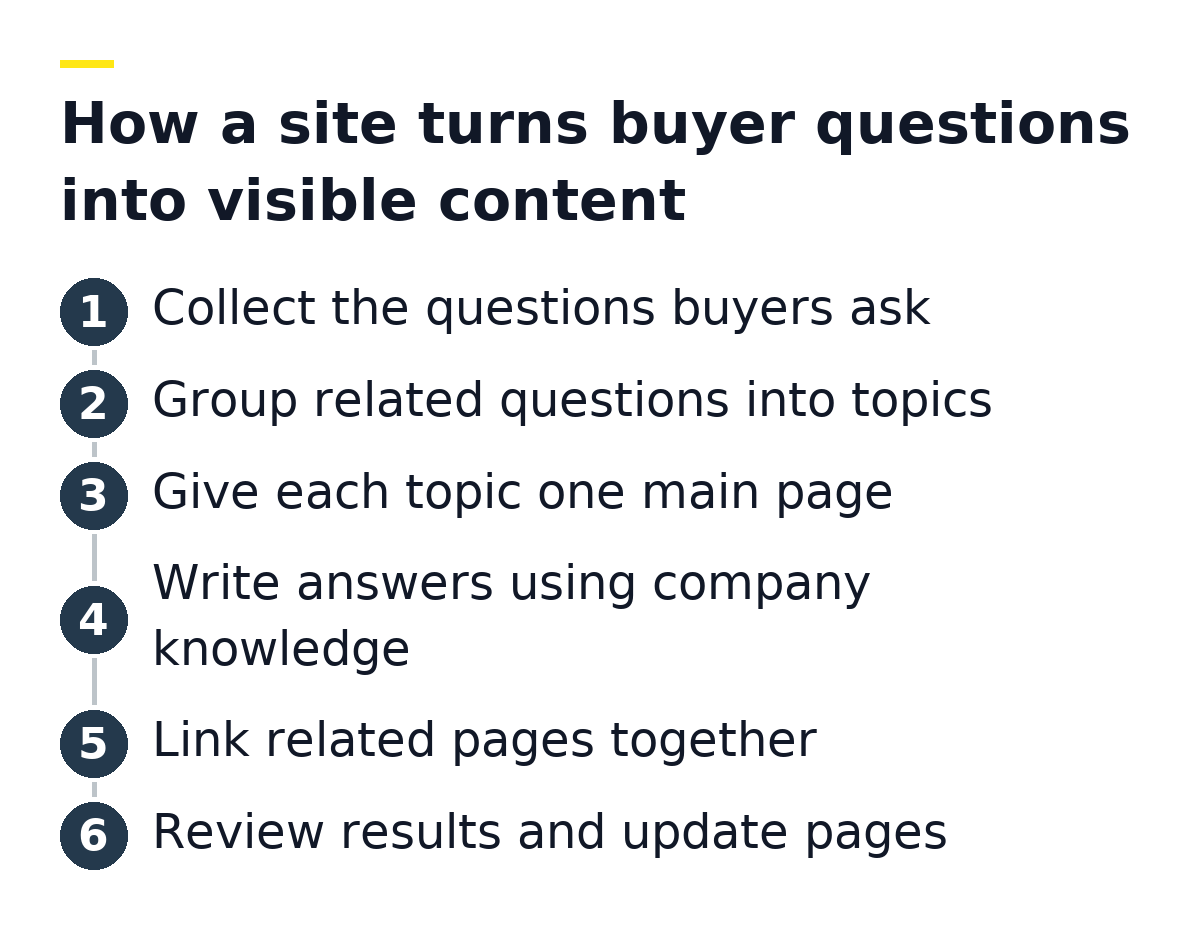
Content is the layer buyers actually see, and it is where most of the effort goes. An optimised site maps its content to the real questions buyers ask at each stage, from early research to the final comparison before purchase.
The comparison below shows how the same business can approach content in two ways. The conclusion is simple: content planned around buyer questions does more work than content planned around what the company wants to say.
| Point | Company-led content | Buyer-led content |
|---|---|---|
| Starting point | Product features and announcements | Questions buyers type or ask AI assistants |
| Typical page | Press release or feature list | Answer to a specific problem |
| Language | Internal product names | Words buyers already use |
| Link to sales | Indirect | Leads from question to relevant product page |
| Use to AI assistants | Hard to quote | Easy to quote as a direct answer |
Buyer-led content also uses what the business already knows. A company's sales call notes, support tickets, product documentation and case studies contain the details that make a page useful and hard to copy. A logistics SaaS company that explains how its routing handles Indian pin code data inconsistencies is writing something a generic article cannot match. Telliscope calls this body of knowledge Company DNA and uses it as the raw material for each article.
Trust signals across the site
Search engines and AI assistants both prefer sources that look reliable. Trust is built across the whole site, beyond any single page. A visitor and a crawler should both be able to tell quickly who runs the business, what it does and whether it is real.
- An about page that names the people and the business
- Contact details, including an address where relevant
- Clear policy pages such as privacy, terms, refunds and delivery
- Author names and roles on articles
- Case studies and customer stories with specific details
- Structured data that labels the organisation, products and articles
- Mentions of the business on other reputable sites
For ecommerce brands in India, refund and delivery pages carry extra weight because buyers check them before paying. For B2B software, specific case studies matter most. A story that names the customer's industry, the problem and what changed is far more convincing than a line of praise.
How AI assistants read an optimised site
AI assistants such as ChatGPT, Claude, Gemini and Perplexity draw on web content to answer questions, and they cite sources they find clear and reliable. G2's 2026 AI Search Insight Report says 51% of B2B software buyers start research with AI more often than Google. A site built only for traditional rankings may miss these buyers.
The good news is that most of the work overlaps. A well-structured page with a direct answer near the top, short sentences and clear headings is easier for both a search engine and an AI assistant to use. The extra habits that help AI visibility are:
- Answer the question in the first sentence or two after a heading
- Keep each paragraph to one idea so it can be quoted alone
- State facts about the business plainly and consistently across pages
- Avoid hiding key information inside images or downloadable files
- Check which buyer questions the business appears for in AI answers
A site can rank well on Google and still be missing from AI answers. The only way to know is to check the questions buyers ask on each AI platform, and to keep checking, because those answers change.
What optimisation looks like for different businesses
The parts are the same for every site, but the emphasis changes with the business model.
B2B SaaS companies. Buyers research for weeks and compare vendors. The site needs depth on use cases, integrations and comparisons, plus content that answers technical questions. Architecture matters because the site often grows to hundreds of pages of documentation, blog posts and landing pages.
Ecommerce and retail brands. Category pages and product pages carry most of the search demand. Speed, image handling and clean category structure matter most, with buying guides supporting the categories. Adobe Digital Insights (2026) reports a higher conversion rate for AI-referred visits to retail sites, at 42%, so being named in AI shopping answers is worth tracking.
Founder-led service businesses. A consultancy or agency often has a small site and strong expertise. The biggest gains usually come from turning that expertise into clear pages on the problems clients bring, and from strong trust signals.
Why an optimised site needs ongoing upkeep
An optimised site does not stay optimised on its own. Products change, prices change, competitors publish and search engines adjust how they rank. A page that was accurate when it went live can describe an old feature within a few months. The Cloudflare CEO (2026) estimates that about 60% of web requests come from bots, including AI agents, so outdated pages keep being read and repeated long after they stop being true.
Upkeep means reviewing which pages are gaining or losing visibility, updating facts, merging pages that compete with each other and filling gaps where buyers ask questions the site does not answer. This is where many small teams fall behind. Writing the first set of pages is manageable. Keeping dozens of them current while running a business is harder.
Software in this space takes different approaches. Writing assistants such as Jasper focus on drafting text, and on-page tools such as Surfer SEO focus on scoring a page against its competitors. Neither runs the full cycle of research, planning, publishing and updating on its own. Telliscope is built around that full cycle, across SEO, GEO and AEO.
Related: What Is SEO and How Does It Work? The Basics for Busy Businesses
Frequently Asked Questions
How to use SEO in a website?
Use SEO in a website by making every layer work together: a technical foundation that lets crawlers reach your pages, a clear architecture, content that answers buyer questions, trust signals and regular updates. Tools can measure where each layer is weak, but the improvement comes from fixing the site itself.
What are the latest SEO updates?
The biggest change in 2026 is the growing role of AI assistants in how buyers find businesses. Search engines keep updating their ranking systems, but the lasting direction is the same: clear, accurate, useful pages from trustworthy sites do well in both search results and AI answers.
If your business does good work but buyers are not finding it, Telliscope can research the questions they ask on Google and AI assistants and turn them into content built from your Company DNA. Starter is ₹14,999 per month plus GST for teams that review content in-house, and Growth is ₹44,999 per month plus GST with managed execution and human review. Book a Telliscope demo to see where your site appears in AI answers today.