
6 SEO Examples From Real Businesses and What Each One Teaches
Six real SEO examples from SaaS and niche sites, with the exact tactics and measured results, plus the shared lessons founders and marketers can apply in 2026.

Six businesses started with a small website and ended with measurable growth in clicks, visitors or sales leads. Each one did it with SEO work you can copy. This article walks through what each business did, the result it recorded and the specific move you can lift for your own site.
SEO (search engine optimisation) is the work of making a website easy for search engines to find, understand and show to people looking for what you offer. An example of SEO is a software company publishing a page that compares its product with a rival, so buyers searching for that comparison land on the company's own site. The examples below go past that definition and show what the work looks like when it produces numbers.
The six cases were picked because each has a documented outcome and a clear set of actions behind it. Three are B2B software companies: Docupilot, Flowace and FlowForma. Two are affiliate or content sites in health and fitness, run by practitioners who published their process. The last is UAV Coach, a niche education site that grew from a single long guide. Together they cover new content, fixing old content, technical clean-up, link building and conversion work.
For founders and small business owners, these are useful because none of them needed a famous brand to work. For marketing leads and demand-gen teams, they show which content types bring leads and which only bring traffic. For ecommerce and retail managers, the content-site examples show how buying-intent searches turn into revenue.

The pattern across all six: each business matched a page to a specific question buyers were already asking, then made that page better than anything else available. Volume helped some of them, but focus on intent and quality is what every one of them shared.
1. Docupilot: a multi-format content plan
Docupilot grew monthly clicks from 1,300 to 8,000 (over 500% growth). Docupilot, a document automation tool, ran a content strategy built on several formats at once. It published 8 blogs every month, built conversion tool pages, released templates and created comparison pages. It also added conversion rate optimisation (CRO) elements so the new visitors had a clear next step.
The lesson from Docupilot is that blog posts alone cover only one kind of search. A buyer who types a question wants an article. A buyer who wants to get a task done wants a template or a working tool. A buyer close to a decision wants a comparison. Docupilot built a page type for each of these moments, so it could appear at more points in the buying journey.
- Publish blog content on a steady schedule (Docupilot kept to 8 a month).
- Build tool pages that solve a small problem on the page itself.
- Release templates people can download and use straight away.
- Write comparison pages for buyers weighing options.
- Add CRO elements such as clear calls to action and sign-up prompts on high-traffic pages.
A practical way to apply this: list the five tasks your customers do just before they need your product. For an Indian GST invoicing tool, that might be creating an invoice format, checking a GST rate or calculating tax on a bill. Each of those can become a template or a small calculator page, and each one sits next to your product in the buyer's mind.
2. Flowace: bottom-of-funnel pages that produce leads
Flowace generated 18 SQLs from a previous count of 0. Flowace, a time tracking and productivity software company, prioritised bottom-of-funnel (BOFU) content. It revamped its comparison pages, fixed technical SEO issues and organised content into a pillar-cluster structure, where one broad page links to several narrower pages on the same theme. The result is measured in sales qualified leads (SQLs), not traffic.
This is the example to show a founder who doubts SEO. Going from zero sales qualified leads to 18 is a pipeline change. The key choice was the order of work: Flowace started with the pages buyers read when they are ready to choose, then filled in the wider topic structure around them. Many teams do the opposite and publish broad awareness articles first, which bring visitors who are years away from buying.
- Start with content for buyers close to a decision: comparisons, alternatives and pricing questions.
- Revamp existing comparison pages so they answer the questions a shortlist buyer has.
- Fix technical issues that stop pages from being crawled or loading well.
- Group content into pillar pages with linked cluster pages on narrower subtopics.
- Measure success in qualified leads, not only in sessions.
For a B2B SaaS team, the takeaway is to judge each planned page by one question: would someone reading this be close to booking a demo? If the answer is yes, that page goes to the top of the queue.
3. FlowForma: getting more from content that already exists
FlowForma recorded a 152% increase in organic visibility and a 65% increase in clicks. FlowForma, a no-code process automation company, optimised its existing underperforming content instead of only adding new pages. It used a pillar-cluster model, focused on BOFU content and applied CRO techniques.
Most sites that have published for a few years carry a library of pages that almost work. They show up on page two, or they rank but rarely get clicked. FlowForma treated those pages as an asset. Updating a page that search engines already know is often faster than waiting for a brand-new page to earn trust.
- Find pages with impressions but few clicks, or rankings just outside the first page.
- Rewrite titles and introductions so they match what the searcher wants.
- Add missing sections, current information and clearer answers.
- Link those pages into a pillar-cluster structure so related pages support each other.
- Add calls to action that fit the reader's stage.
Google Search Console is the free place to start this work. Its performance report shows which pages get seen but not clicked, which tells you where a better title or a fuller answer will pay off quickest.
4. Mario Deal's health and fitness client site: a clean-up first
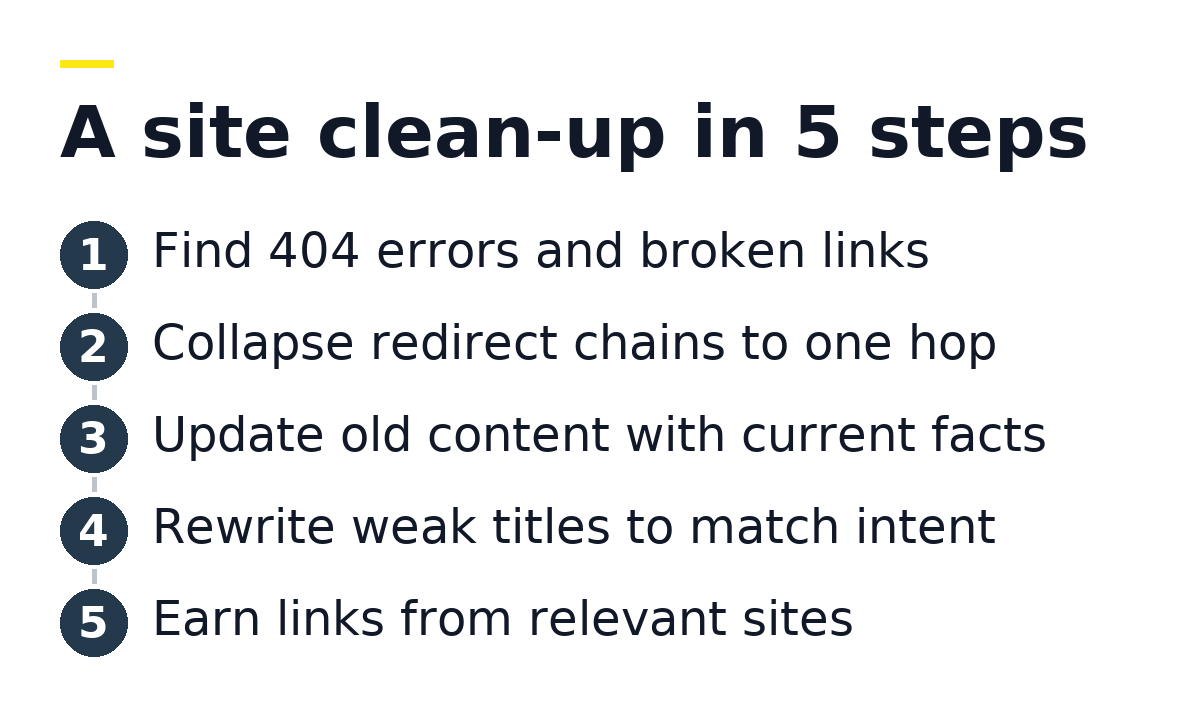
Mario Deal's health and fitness client site quadrupled its traffic in 6 months. SEO practitioner Mario Deal worked on a health and fitness site by updating old content, cleaning up 404 errors and redirect chains, improving titles and keywords, and running a guest posting campaign.
Broken pages and redirect chains are the kind of problem that grows unseen. A product gets discontinued, a URL changes, and a few years later the site has dozens of dead ends. A 404 error means a link leads to a page that no longer exists. A redirect chain means one URL forwards to another, which forwards to another, slowing down both visitors and search engine crawlers. Fixing these lets the authority a site has already earned flow to the pages that matter.
- Update old articles with fresh information and clearer structure.
- Find and fix 404 errors, either by restoring the page or redirecting to the closest match.
- Collapse redirect chains so each old URL points straight to its final destination.
- Rewrite titles and refine keyword targeting on existing pages.
- Earn links through guest posts on relevant sites.
Ecommerce brands should pay close attention here. Online stores remove products and change category URLs often, so they collect broken links faster than most sites. A quarterly check for 404s and chains is a cheap habit with a direct payoff.
5. Matthew Woodward's weight loss supplements site: audit, depth and links
Matthew Woodward's weight loss supplements site grew from 2K to over 38K visitors per month. SEO practitioner Matthew Woodward combined three pieces of work on a weight loss supplements site: a technical SEO audit, long-form content and link building.
Supplements is a crowded and sensitive niche, where search engines expect careful, trustworthy content. That makes the result a useful example of what the full set of SEO work can do together. The audit made sure nothing on the site was blocking performance. The long-form content gave each page enough depth to fully answer a buyer's question. The links gave the site outside signals that it deserved to be trusted.
- Run a technical audit before publishing more, so new content lands on a sound site.
- Write long-form pages that answer the full question, including the follow-up questions a buyer has.
- Build links from relevant, credible sites to the pages you most want to rank.
For a retail brand selling health, beauty or wellness products in India, the parallel is clear. Buyers research ingredients, side effects and comparisons before they spend. Detailed, honest pages that answer those questions earn both visitors and trust.
6. UAV Coach: one guide that did the heavy lifting
UAV Coach published one guide that ranked #1, brought 21.4% of total traffic and 2335 new email subscribers. Michael Karp of UAV Coach, a drone training site, created a 4400-word guide called 'How to Fly a Quadcopter - The Ultimate Guide'. The post ranked #1, brought in 21.4% of the site's total traffic and added 2335 new email subscribers, according to the case study.
UAV Coach shows that a small business does not need hundreds of pages to be found. It needs the single best answer to a question its future customers ask. The guide also captured email subscribers, so the visitors did not leave and disappear. They joined a list the business could keep talking to.
- Pick the one core question a beginner in your field asks first.
- Write the most complete, useful answer to it, with steps a reader can follow.
- Add an email sign-up or lead offer inside the guide.
- Keep the guide updated so it holds its position.
A coaching institute in Pune, a home bakery supplier in Kochi or a CA firm in Ahmedabad can each use this model. Each has one beginner question it answers every week by phone. Writing that answer in full, once, on the website lets it work around the clock.
The table below shows which lever each business pulled hardest. No single approach won: the right one depended on where each site started.
| Business | Main tactic | Recorded outcome |
|---|---|---|
| Docupilot | Multi-format content plus CRO | Clicks from 1,300 to 8,000 a month |
| Flowace | BOFU and comparison pages | 18 SQLs from 0 |
| FlowForma | Optimising existing content | 152% visibility, 65% clicks increase |
| Mario Deal's client site | Clean-up, updates, guest posts | Traffic quadrupled in 6 months |
| Matthew Woodward's site | Audit, long-form, links | 2K to over 38K visitors a month |
| UAV Coach | One 4400-word guide | #1 ranking, 2335 subscribers |
SEO examples for small businesses in India
The six cases translate directly to small businesses with modest budgets. Small teams often assume SEO needs a large content department. Mario Deal's client site and UAV Coach show otherwise: one did a clean-up, the other wrote one great guide.
- A local dental clinic can update its old treatment pages with current prices described in words, clear steps and answers to common fears, as Mario Deal did with old content.
- A D2C skincare brand can write long, honest ingredient guides, as Matthew Woodward's site did with long-form content.
- A B2B software startup in Bengaluru can publish comparison pages before anything else, as Flowace did.
- An accounting firm can release free templates such as a monthly expense sheet, as Docupilot did with templates.
- A training academy can write the one definitive beginner guide for its field, as UAV Coach did.
- A business with an older site can fix its weakest existing pages first, as FlowForma did.
In 2026, the same pages also matter for AI assistants. When a buyer asks ChatGPT, Claude or Perplexity a question, those tools draw on clear, well-structured pages that answer it directly. G2's 2026 AI Search Insight Report says 51% of B2B software buyers start research with AI more often than Google. A page written to be the best answer to a buyer's question serves both kinds of search.
What they have in common
The six businesses worked in different industries and used different tactics, yet the same habits show up across them. None chased search terms at random. Each chose pages that matched what a specific buyer wanted, built those pages well and gave the reader something to do next.
- They matched each page to a clear buyer intent, from beginner question to final comparison.
- The software companies put decision-stage content first, because it produces leads.
- Several improved existing pages before adding new ones.
- They fixed technical problems so good content was not held back by a broken site.
- They went deep on topics, with long, complete answers.
- They earned links from relevant sites where competition demanded it.
- They added a next step, such as CRO elements, sign-ups or demo prompts.
- They measured outcomes that mattered to the business: clicks, visitors, leads and subscribers.
Consistency is the hidden factor behind all of them. Docupilot kept to a monthly publishing rhythm. Mario Deal's result took 6 months. SEO results compound, so the businesses that keep going are the ones that see them.
Several platforms promise to handle this work. Writing tools such as Jasper focus mainly on drafting copy, which leaves strategy, publishing and ongoing improvement to your team. Telliscope covers the full cycle: it turns real buyer questions into researched content using a company's own knowledge (its Company DNA), publishes it and keeps improving it for Google and AI assistants.
Related: What Is SEO and How Does It Work? The Basics for Busy Businesses
FAQ
What is an example of effective SEO?
Flowace is an example of effective SEO because its results were measured in sales leads. By prioritising bottom-of-funnel content, revamping comparison pages, fixing technical SEO and using a pillar-cluster structure, Flowace generated 18 SQLs from a previous count of 0. Effective SEO brings visitors who are ready to act, not only more visitors.
Is Google Ads a form of SEO?
Google Ads is not SEO. Google Ads is paid search advertising, where a business pays for its ad to appear in sponsored spots. SEO earns unpaid, organic placement by making pages that search engines judge to be the best answer.
The two work differently over time. Ads stop bringing visitors the moment the budget stops. The pages in the six examples above kept bringing visitors after the work was done, because each page kept answering a question people kept asking. Many businesses use both: ads to test which messages convert, and SEO to build traffic they do not pay for per click. Notice that none of the six examples relied on ads for their result.
Want the Docupilot or Flowace approach without building a content team? Telliscope writes, publishes and improves researched content from the questions your buyers ask on Google, ChatGPT, Claude and Perplexity. Starter costs ₹14,999 per month plus GST for 15 articles a month, and Growth adds human review and managed execution at ₹44,999 per month plus GST. Book a Telliscope demo and get a list of the first buyer questions your site should answer.